How to Design a Home That Inspires You in 2026
At Plain English, we recognize the significance of selecting hardware, or ‘ironmongery’ and the visual and mechanical cohesion it brings to a room. We regard it as the ‘jewelery’ of the cupboards we design and make. Beyond its decorative role, the tactile quality of hardware renders it an essential consideration in the creation of a kitchen that is both functional and enduring.
Outlined below are several key factors – including proportion, finish and placement – to help inform the selection.
The Importance of Hardware: A Considered Detail
Cabinet hardware is the element of a kitchen most frequently touched. It is the primary point of contact – opened, closed, grasped and leaned on throughout the day. For that reason alone, it deserves careful and deliberate thought.
Beyond function, hardware underscores the character of cabinetry. A subtle shift – from a rounded knob to a more slender pull – can alter the rhythm across a run of cupboards, while the repetition of handles along a bank of drawers introduces a sense of structure and balance. In kitchens informed by traditional English furniture, these details contribute to a sense of quiet order.
There is a distinction between visual impact and everyday comfort. Certain pieces may look striking in photographs but feel awkward or unmanageable in use. The most successful choices achieve both: they complement the look of the cabinetry while remaining intuitive and satisfying to the touch.
Start with Proportion
Proportion in hardware is as much sensed as it is seen. The relationship between the scale of a handle and that of the door or drawer is quietly influential: wider drawers tend to suit longer pulls that echo their horizontal line, whilst narrower cupboards are often better served by smaller handles or more traditional knobs.
Hardware that is overly large can dominate finely detailed joinery, particularly within framed cabinetry where rails and stiles already establish a clear structure. Equally, pieces that are too slight may feel diminished against broader painted surfaces.
A useful guide is to assess the length of a pull in relation to the width of the drawer. In many instances, a proportion of approximately one third offers a pleasing balance, though such measures are never absolute.
It is also worth considering repetition in the scheme of the kitchen. When the same handle is used throughout, its size should remain harmonious, contributing to a steady visual rhythm rather than disrupt it.
The Style of the Cabinetry
The style of the cabinetry itself should inform hardware selection. Framed cabinetry, particularly in traditional kitchens, is well-suited to classic knobs, cup pulls or gently curved handles. These shapes echo heritage designs and reinforce a sense of craftsmanship. Minimalistic or contemporary settings can accommodate more linear pulls with clean lines. In these settings, hardware often becomes a subtle architectural detail rather than a decorative feature.
Where styles are combined, restraint is essential. Combining knobs and pulls can work beautifully, but introducing too many shapes or silhouettes risks creating visual clutter. Compatibility should always take precedence over novelty.
Trend-driven choices, meanwhile, can quickly date. Hardware ought to support the enduring character of the kitchen, enhancing its longevity rather than competing with it.
Choosing the Right Finish
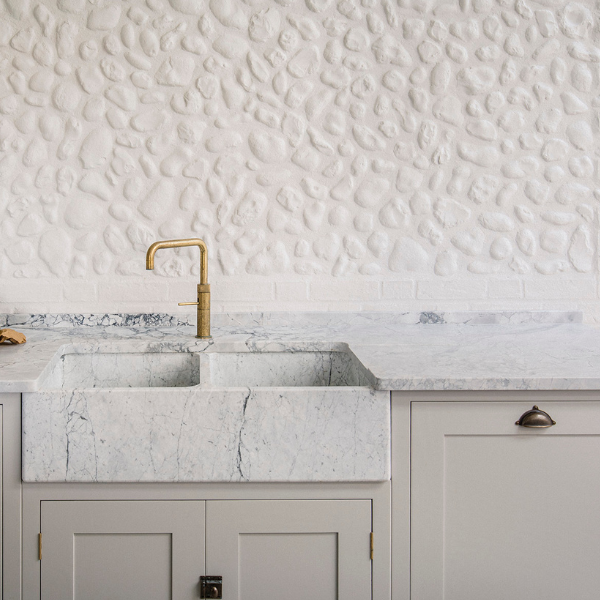
When finalizing kitchen cabinet hardware, finish goes hand in hand with form in achieving the final atmosphere of the room. Unlacquered brass introduces warmth and depth. Brushed nickel offers softness without appearing dull. Burnished bronze feels grounded and understated. Polished chrome brings brightness and crispness.
How finishes interact with painted cabinetry is an important consideration. Warmer paint tones often pair well with aged or brushed metals, while cooler shades may suit nickel or chrome.
Patina should also be noted. Certain finishes improve with age, developing subtle variation over time, while others remain consistently polished. Neither approach is inherently right or wrong; the choice ought to be both personal and intentional.
Matching taps and light fixtures exactly is not always necessary, but complementing tones across metal finishes can lend itself to feeling more lived-in. It can also be effective to match the metal finish to the architectural style of the home, for example choosing finishes that welcome patina in a more traditional setting.
The Tactile Experience
Weight, texture and grip are key considerations for selecting hardware that is touched every day . A handle should feel reassuring without being cumbersome.
Curved handles tend to sit comfortably in the hand, while angular designs create sharper visual lines. The right choice depends on the overall tone and intent of the kitchen.
Where possible, it is advisable to visit a showroom and test options in person, as photographs seldom convey true weight or balance. Hardware choices should be towards the considered and functional, rather than the purely decorative.
Placement and Consistency
Thoughtful placement of kitchen hardware influences both the look and function of the space. Knobs are typically centered on framed doors, aligning with rails and stiles. Pulls are usually placed horizontally on drawers, positioned consistently across the cabinetry run.
Tall cabinets require particular attention. Maintaining alignment from lower drawers through to upper doors helps preserve a sense of visual order.
Careful alignment ensures hardware supports the architecture of the cabinetry and the kitchen as a whole, rather than detracting from it.
Mixing Hardware Thoughtfully
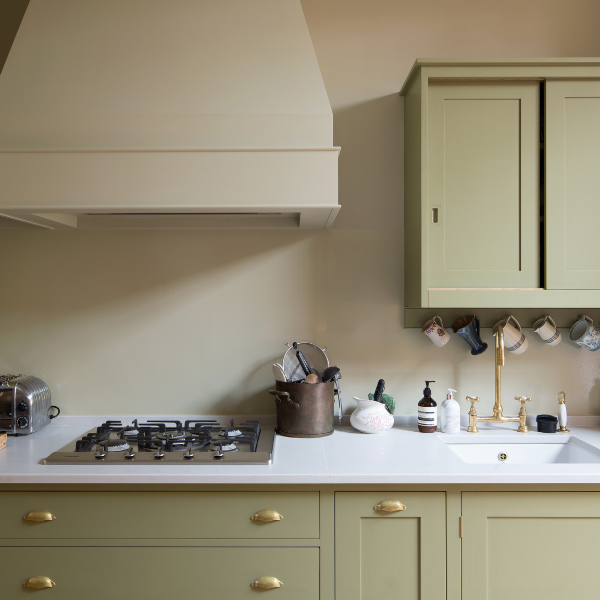
There are instances where mixing hardware can be both practical and elegant. For example, cup pulls on drawers paired with knobs on doors can be a welcome combination. The distinction subtly reinforces function – pulls for heavier drawers, knobs for lighter cupboard doors.
However, excessive variations in shape or finish can disrupt the room’s composition. Limiting the palette keeps the overall scheme cohesive throughout the scheme. When combining styles, it’s generally best to maintain a consistent finish or material to create continuity even where designs differ.
Attention in the Details
Hardware is beyond just the finishing touch to the kitchen – it is integral to the visual language, functionality and experience of the space.
At Plain English, we accompany you through every stage of your kitchen’s design, from the initial spatial planning to the careful selection of the final finishes. Ours is a comprehensive design experience, offering exclusive, hand-cast hardware options, thoughtfully curated to ensure that proportion, finish and placement all align seamlessly with the intended vision.
If you are currently undertaking a renovation and wish to explore the possibility of working together, we invite you to visit one of our showrooms, speak with a designer or request a brochure to explore the range of possibilities available.